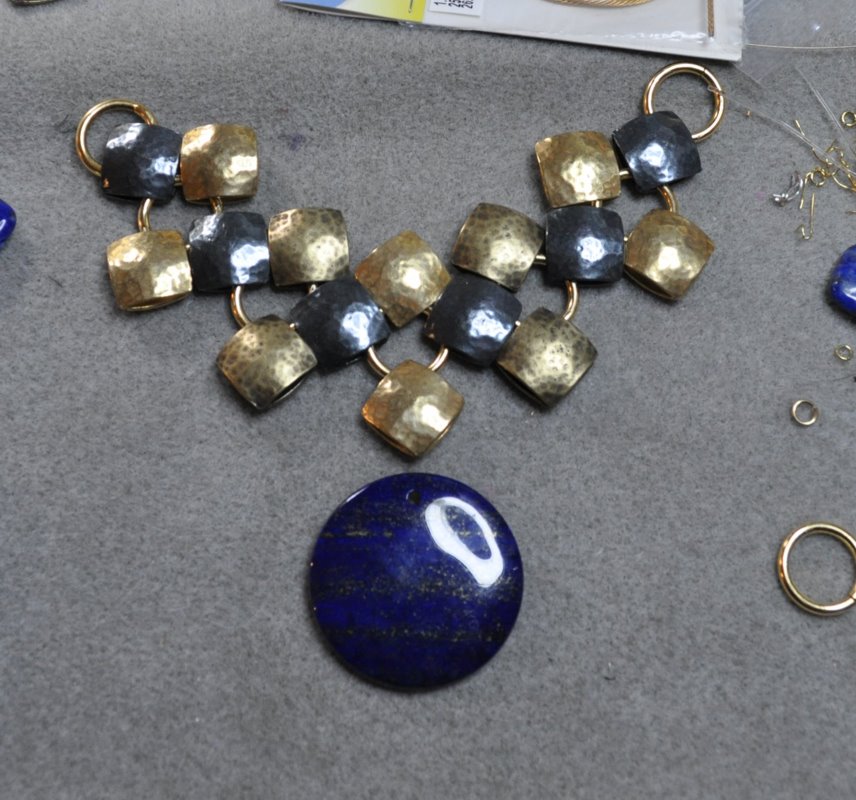
I get a lot of questions about my photography techniques. One of the things that is really important in photographing beads and jewelry is to have an uncluttered background that does not detract from the item being photographed.
I often use a "stage" - a plexiglass sheet with a silvery backing to create a soft reflection of the bead in question.
But glass scratches plexiglass - and over time - it develops a haze of fine scratches that seriously detract from the professionalism of the finished picture. If you were photo'ing anything of normal size - no one would notice - but zooming in on these tiny items ... the scratches look huge and messy!
See? Ew.
Scratch remover to the rescue. This scratch remover polish comes in a different grades - depending on the depth of the scratches - and is excellent for removing those fine scratches that detract from the look of the stage. Just put a tiny dot on and rub with a very soft cloth.
et voila! Scratches significantly reduced - (apparently - I also need some of the next size up - for deeper scratches).
Also works for scratches on plastic sunglasses - oh, and for scratches and haze on plexiglass airplane canopies - which is what it is actually sold for. ;-)
BeadFX - a Canadian bead store - staffed with crazy bead ladies. We post beady tips, video clips, stories, notices about classes and sales, and sometimes totally irrelevant stuff that we think is interesting and you might too!
Showing posts with label tips. Show all posts
Monday, September 17, 2012
Friday, August 31, 2012
Design Iterations - 4 designs that didn't make it
As I explained - with last Wednesday's inspiration - there was quite a journey from initial idea to the eventual "Incarnation."
But the choice of blue stone - once I had it in my head that I wanted to do a blue stone pendant - well - I tried a number of different shapes - here is what I tried and why I rejected them.
Maybe this will give you some inspiration in the future - when you are trying to make a design decision!
I toyed with multiple dangles - I eventually rejected this idea as I really like the way it looked without it - and I wasn't sure if they were going to lay the way I wanted - and - having got it right - I just didn't want to mess with it any more. That's a fair reason, right? ;-)
I tried the rectangle - and really liked the look of the teardrop pendant better. I think the rectangle is too similar to all the squares. It looks like a swing and a miss.
I like it - but ... not as much as the teardrop. Maybe because the square and the round are too similar - even shapes - circle fits in a square ... . It's not bad - but the drop is better.
This dumorterite was also on my desk - I love the funky shape - but as the colour is a duller blue - it is too similar to the gunmetal - just doesn't pop enough.
Maybe you do the same thing - lay out the pieces and try different looks? Try it - sometimes figuring out why you don't like it as useful as finding something you do like!
Monday, January 24, 2011
So you want to make Jewelry? Stringing a Basic Bracelet
So - you want to make jewelry? Welcome to our world, little frog - it's a big, wonderful place, full of colour and passion and choices. Many, many choices.
First, we are going to talk about "stringing." It is probably easy for you to guess that by this, we mean threading beads through their holes onto some sort of long, thing stringy stuff and tying a knot. Yes indeedy. That's it. You now know how to make jewelry. Go away now, and let the master rest.
What - you don't think that is the all and the whole of it? Very wise little frog you are.
Hmmmm. I will tell you a story.
Once upon a time, many, many grandmothers ago, someone found a shell on the beach. And the wind and the water and the rubbing of the sand had made a hole in it. And someone picked it up and said, "Whoa man, is this ever cool!" And then, someone else said, "Hey, I found one too, and mine is cooler than yours," and the next thing you know, everyone is down on the beach looking for cool shells with holes. Because even though all those people owned was a fire-hardened stick and the latest in genuine leather clothing, they knew the value of a cool shell when they saw it.
And when they had their hands full of shells, and couldn't figure out how to carry any more of them, their mother stopped mending their ripped leather leggings and took a piece of leather, cut very thin to make a cord, and put all the shells on it, and tied a knot, and hung it around their necks.
And the shells made a pleasant sound as the rubbed together when they ran. And at night, they sat around the fire and the shiny surfaces glinted in the firelight and looked magical. And they made up stories about the shells, and the people who wore them. And it was good.
Fast forward to today - we are still putting shiny stuff on string and hanging it on our bodies. I'm pretty sure it's now hardwired into our genes. But we've come up with a few more choices than shells with holes and leather cord.
Many, many choices. But I am not going to overwhelm you with them today.
You are going to start with this: Softflex (tm) Beading Wire - 30 ft .019 (Medium) - Silver Grey (Spool)
This is an excellent beginner's choice, as it is not too thick, not too thin, strong, won't change colour, resists wear, doesn't kink (unless you really work at it), and is a neutral color. It's is, in the words of the immortal philosopher, Gholdi Lahks, "Just Right."
You are going to make a bracelet. The standard size for a bracelet is 7 inches, end to end. Here is a secret. You are making it. It doesn't have to be standard.
If you are a tiny little slip of a thing with delicate wrists - 6 inches or 6.5 might fit better. If you are a woman of substance that would have made Rubens reach for his paintbrushes - you might prefer an 8 inch bracelet. If you are a dude, and are looking for something showy for the next gala opening - 9 inches might suit better. 7 inches is an AVERAGE.
And, just to complicate things - if you pick out thick beads - you need to make the bracelet longer, because when you curve it around your wrist, the thickness of the beads will take up space and make it shorter.
Now, you need some beads. Hoo boy. Not even I can make this easy.
Here's the store - go pick something out.
Here are some projects from our inspirations pages that are simple, stringing projects.
Cubic Bling Bling (pictured)
Hong Kong Nights
In a Mood
Hearts Afire
Copper Cafe
Stardust Mocca
Heaven and Earth
Simply Elegant
Butterfly Garden

Stormy Weather
Midnight Toast (pictured) (yes, really - same technique!)
Happy New Year
A Splash of Seafoam
OK - got some ideas now?
If I am making a design that I have made before, or it is a simple design and I don't have to worry about whether it will "work" or not, like the "Midnight Toast" bracelet above, I will simply unspool (but not cut) about 10 inches of the beading cable, string the beads on the cable, attach one half of the clasp, and then cut the wire, and attach the rest of the clasp to the other end.
If I am playing with the design, however, or not sure what order the beads or the colours should go in, then I cut the piece of beading wire, and start my design from the middle - adding beads on both sides to keep the design balanced, once I have figured out what order they should go in. This often involves trying a few beads together, maybe changing the order and trying again, taking some off and changing them around, until I get something that "feels right." "Would I wear that," I think? If the answer is "No," I try again.
Be generous when you cut the wire. If you are making a 7 inch bracelet, don't cut 8 inches of wire. Leave at least 4 inches on each end, sometimes more. (I can hear the horrified gasps from here.) This is because bending the beading wire around and stuffing it back into the crimp bead (more on that in a bit) to attach the clasp can be fiddly work, and it is waaaay easier if you have lots of cable to grab. Life is short - don't make it hard for yourself.

After the beads, you will need crimps, which are the do-hickeys we use instead of knots to fasten the beading wire, and a clasp.
There are lots of choices in crimps, but this is a good starting point.
Sterling Crimps - 2 x 2 mm Crimp Tube - Sterling (50)
For that matter, there are lots of choices in clasps. (We have, at this moment, 653 different clasps.) This one is inexpensive, durable and a classic design.
Findings - Clasps - Toggle - 12 mm Classic Stationed - Pewter (1)
As to getting the crimp on, and the clasp - I could blather on about that - or you can watch the video here, because seeing is much easier than reading a description.
And that - fundamentally - is it. A necklace is just a longer bracelet. Oh, sure, there are different styles of clasps. You can do multiple strands. There is an incalculable number of ways to combine the various beads. But that, little frog, is stringing in a nutshell.
Go forth and create jewelry. Next week - I will talk about the types of clasps.
Here are some links to useful tips we have published. We keep this list up-to-date here.
Questions? Leave a comment!
First, we are going to talk about "stringing." It is probably easy for you to guess that by this, we mean threading beads through their holes onto some sort of long, thing stringy stuff and tying a knot. Yes indeedy. That's it. You now know how to make jewelry. Go away now, and let the master rest.
What - you don't think that is the all and the whole of it? Very wise little frog you are.
Hmmmm. I will tell you a story.
Once upon a time, many, many grandmothers ago, someone found a shell on the beach. And the wind and the water and the rubbing of the sand had made a hole in it. And someone picked it up and said, "Whoa man, is this ever cool!" And then, someone else said, "Hey, I found one too, and mine is cooler than yours," and the next thing you know, everyone is down on the beach looking for cool shells with holes. Because even though all those people owned was a fire-hardened stick and the latest in genuine leather clothing, they knew the value of a cool shell when they saw it.
And when they had their hands full of shells, and couldn't figure out how to carry any more of them, their mother stopped mending their ripped leather leggings and took a piece of leather, cut very thin to make a cord, and put all the shells on it, and tied a knot, and hung it around their necks.
And the shells made a pleasant sound as the rubbed together when they ran. And at night, they sat around the fire and the shiny surfaces glinted in the firelight and looked magical. And they made up stories about the shells, and the people who wore them. And it was good.
Fast forward to today - we are still putting shiny stuff on string and hanging it on our bodies. I'm pretty sure it's now hardwired into our genes. But we've come up with a few more choices than shells with holes and leather cord.
Many, many choices. But I am not going to overwhelm you with them today.
This is an excellent beginner's choice, as it is not too thick, not too thin, strong, won't change colour, resists wear, doesn't kink (unless you really work at it), and is a neutral color. It's is, in the words of the immortal philosopher, Gholdi Lahks, "Just Right."
You are going to make a bracelet. The standard size for a bracelet is 7 inches, end to end. Here is a secret. You are making it. It doesn't have to be standard.
If you are a tiny little slip of a thing with delicate wrists - 6 inches or 6.5 might fit better. If you are a woman of substance that would have made Rubens reach for his paintbrushes - you might prefer an 8 inch bracelet. If you are a dude, and are looking for something showy for the next gala opening - 9 inches might suit better. 7 inches is an AVERAGE.
And, just to complicate things - if you pick out thick beads - you need to make the bracelet longer, because when you curve it around your wrist, the thickness of the beads will take up space and make it shorter.
Here's the store - go pick something out.
Here are some projects from our inspirations pages that are simple, stringing projects.
Cubic Bling Bling (pictured)
Hong Kong Nights
In a Mood
Hearts Afire
Copper Cafe
Stardust Mocca
Heaven and Earth
Simply Elegant
Butterfly Garden
Stormy Weather
Midnight Toast (pictured) (yes, really - same technique!)
Happy New Year
A Splash of Seafoam
OK - got some ideas now?
If I am making a design that I have made before, or it is a simple design and I don't have to worry about whether it will "work" or not, like the "Midnight Toast" bracelet above, I will simply unspool (but not cut) about 10 inches of the beading cable, string the beads on the cable, attach one half of the clasp, and then cut the wire, and attach the rest of the clasp to the other end.
If I am playing with the design, however, or not sure what order the beads or the colours should go in, then I cut the piece of beading wire, and start my design from the middle - adding beads on both sides to keep the design balanced, once I have figured out what order they should go in. This often involves trying a few beads together, maybe changing the order and trying again, taking some off and changing them around, until I get something that "feels right." "Would I wear that," I think? If the answer is "No," I try again.
Be generous when you cut the wire. If you are making a 7 inch bracelet, don't cut 8 inches of wire. Leave at least 4 inches on each end, sometimes more. (I can hear the horrified gasps from here.) This is because bending the beading wire around and stuffing it back into the crimp bead (more on that in a bit) to attach the clasp can be fiddly work, and it is waaaay easier if you have lots of cable to grab. Life is short - don't make it hard for yourself.
After the beads, you will need crimps, which are the do-hickeys we use instead of knots to fasten the beading wire, and a clasp.
Sterling Crimps - 2 x 2 mm Crimp Tube - Sterling (50)
For that matter, there are lots of choices in clasps. (We have, at this moment, 653 different clasps.) This one is inexpensive, durable and a classic design.
Findings - Clasps - Toggle - 12 mm Classic Stationed - Pewter (1)
As to getting the crimp on, and the clasp - I could blather on about that - or you can watch the video here, because seeing is much easier than reading a description.
And that - fundamentally - is it. A necklace is just a longer bracelet. Oh, sure, there are different styles of clasps. You can do multiple strands. There is an incalculable number of ways to combine the various beads. But that, little frog, is stringing in a nutshell.
Go forth and create jewelry. Next week - I will talk about the types of clasps.
Here are some links to useful tips we have published. We keep this list up-to-date here.
- Five Things you need to know to make jewelry
- Part 1 - A secure knot - the Surgeon's Knot
- Part 2 - Crimping
- Part 3 - Making Wrapped Loops
- Part 4 - Opening Jumprings
- Part 5 - Making a Simple (unwrapped) Loop
- Rapid Loops - Quick and Dirty Wrapped loops - made FAST
- Stringing Choices - what to string on
- How to use a cone for a nice end
- Making a multi-strand necklace
- Detailed instructions for making your own Rhinestone Transfers, and applying to fabric.
- Stretchy Bracelets
- Wiring a Briolette (Drop)
- Fixing it when the crimp comes undone and you don't want to re-string the entire necklace.
Questions? Leave a comment!
Monday, January 03, 2011
Attaching Swarovski Hot Fix
Last week - I said I would talk more about actually getting the Swarovski Hot Fix Rhinestones onto the fabric.
First, a word about what you are attaching to. The hot fix glue needs some sort of surface that it can penetrate into. If you have a new garment, you need to wash it first to remove the sizing and make it so that the fibers will absorb the glue. You can do a water droplet test. If you flick water droplets onto the fabric and they stand up on the surface, you will need to wash it. If they absorb in, they the fabric is good to go. Some materials are not suitable, such as organza, smooth leather and smooth leather imitations, very tightly woven polyamides and fabrics with a silicon or wax finish that prevents absorption. Like a rain slicker. No sparkly rain slickers. Kind of a shame, really - because you need a little sparkle on a rainy day.
Often, you will get a blend of fabrics - pick a lower temperature based on the more delicate fabric - the one that will take less heat, and go for the longer of the two times.

*Trevira is some sort of artificial fabric - never heard of it here. No idea what a Technical Fabric is - "Technically - it's a fabric!" - and Fake Fur? Seriously? Rhinestones on fake fur? Gilding the lily, much?
Finding something to bling up
Well - the obvious - t-shirts, denim jackets, jeans, vests. My personal current favourite however is scarves. There are a ton of reasonably priced scarves in the stores right now, from Ardene to Walmart, in plain colours (black is always great) that can look uber-fabulous with the addition of some bling. From Drabulous to Fabulous in 20 seconds flat.
This massive, gorgeous scarf is just dying to be sparkled up!

Stuff you'll need.
Teflon sheets. 2 - one for the top, one for the bottom. The bottom one stops any glue that might sneak through the fabric from gluing itself to the next layer. If you don't have teflon sheets handy, (we sell them, or some baking supply places have them, and art clay supply) clean newsprint or butcher paper will do.
A heat proof silicon, felt, cardboard or other pad. It pays to have some squishiness - so the stones can sink down into the fabric under pressure.
Heat source. Household iron - but no steam, or industrial purpose-specific rhinestone transfer press. I can't find my iron - I use the stores' press. You can too - with the purchase of a rhinestone transfer or minimum 2 packages of hot fix stones & silicon transfer film.

So - here's the transfers that I made in the past week.

And here's another - this is a commercial transfer - is it not just to die for? I don't believe it is actually Swarovski stones - I know - sacrilege! But it is the inspiration for me to try making my own transfers!
And here is the scarf - it is a blend of fabrics, as you can see, so I decided, based on the chart above, to go with 250 degrees F and 25 seconds.
Start warming up the press or your iron while you are getting ready. It may be tougher, if you have an old iron, to actually figure out temperatures - some have them marked, some don't. You might have to work backwards from the fabric settings and guess what the temperature is most likely to be. It is also very important to NOT use steam, so you have to be able to either turn the steam off, and or dump the water out. Steam will compromise the bonding power of the glue.

Take the transfer and trim around the edge of the design. The glue from the transfer sheet will make a mark on the fabric which will fade with time and washing, but it is better to have a shape that reflects the design, instead of a big ol' rectangular box around your design.
Don't trim so much that you can't actually keep the transfer in place.

Peel the white backing off,
And flip the transfer - sticky side down, stones facing up, and place it where you want it to be. You can peel it off and move it if needed. If you are placing this on a garment where the positioning is critical, like an arm patch, put the garment on, position the transfer, and then have a friend help hold the transfer in place while you struggle out of the garment.
Position the garment and transfer in the press. The press has a silicon pad underneath, built-in, so in this case, just put a sheet of teflon underneath. If you are hot-fixing to a dimension item like sleeve - put the teflon INSIDE the sleeve, so you don't inadvertently glue the front of the sleeve to the back. (Pockets - very important to put the teflon inside the pocket - so as to not render the pocket useless by virtual of accidentally gluing it shut. Not saying it will happen - just - you know, in case. )
Smooth out the wrinkles - so you don't press wrinkles into the fabric, and pick off the dog and cat hairs, so you don't permanently glue them on as well.
If you are using an iron, the ironing board will probably have enough padding for a little give, or if you decided that ironing boards are too much work to move and gave yours up years ago, a folded blanket or sheet or towel will suffice too.
Cover with another teflon sheet for protection, ...
and swing the top of the press into place, and press the lever down. Start your timer.
For using an iron, place it in position and put some weight on it, lean on it. Do NOT, NOT, NOT "iron" - as in moving the iron around. Pressure, no movement. If the iron doesn't cover the whole transfer, do it in stages. (And - remember - no steam.)
Then, pick up the iron and move it a little to one side, and press and heat again, so that any stones that wound up in the "holes" in the face of the iron get equal time.
Let it cool for a minute or two, to let the glue set, and prevent burning yo' fingars.
Start to peel the transfer up, SLOWLY - checking that the stones have all transferred successfully.
If they have not, and are coming away with the silicon sheet, put the transfer back down in place, and reheat. Then wait longer before peeling.
The successfully transferred transfer.
And minutes later, all of them!
And the magnificent Dragon. This had slightly different timing in the instructions, so I followed the instructions - after it didn't work the first time. :-P
The finished scarf. Warm and sparkly!

(Secret Hot Tip) - You've read this far - you deserve a treat. We will be adjusting prices on the hot-fix, downward!, in the next couple of weeks - so you might want to sit tight on a major hot-fix buying binge - as you will save significant moola if you can wait!
So, what if what you really want to stick the stones to is metal, porcelain, wood, etc.? Then you need to go to the non-hot-fix flatbacks, and attach them with epoxy. The hot-fix glue is not designed for non-porous surfaces, and they won't stay stuck. This is a good thing - it prevents people from ironing their Ipads.
Oh, but you can epoxy hot-fixes to your Ipad - if hot-fixes are the only crystals you have on hand and you need to get the job done.
Happy Hot Fixing!
First, a word about what you are attaching to. The hot fix glue needs some sort of surface that it can penetrate into. If you have a new garment, you need to wash it first to remove the sizing and make it so that the fibers will absorb the glue. You can do a water droplet test. If you flick water droplets onto the fabric and they stand up on the surface, you will need to wash it. If they absorb in, they the fabric is good to go. Some materials are not suitable, such as organza, smooth leather and smooth leather imitations, very tightly woven polyamides and fabrics with a silicon or wax finish that prevents absorption. Like a rain slicker. No sparkly rain slickers. Kind of a shame, really - because you need a little sparkle on a rainy day.
Often, you will get a blend of fabrics - pick a lower temperature based on the more delicate fabric - the one that will take less heat, and go for the longer of the two times.

*Trevira is some sort of artificial fabric - never heard of it here. No idea what a Technical Fabric is - "Technically - it's a fabric!" - and Fake Fur? Seriously? Rhinestones on fake fur? Gilding the lily, much?
Finding something to bling up
Well - the obvious - t-shirts, denim jackets, jeans, vests. My personal current favourite however is scarves. There are a ton of reasonably priced scarves in the stores right now, from Ardene to Walmart, in plain colours (black is always great) that can look uber-fabulous with the addition of some bling. From Drabulous to Fabulous in 20 seconds flat.
This massive, gorgeous scarf is just dying to be sparkled up!
Stuff you'll need.
Teflon sheets. 2 - one for the top, one for the bottom. The bottom one stops any glue that might sneak through the fabric from gluing itself to the next layer. If you don't have teflon sheets handy, (we sell them, or some baking supply places have them, and art clay supply) clean newsprint or butcher paper will do.
A heat proof silicon, felt, cardboard or other pad. It pays to have some squishiness - so the stones can sink down into the fabric under pressure.
Heat source. Household iron - but no steam, or industrial purpose-specific rhinestone transfer press. I can't find my iron - I use the stores' press. You can too - with the purchase of a rhinestone transfer or minimum 2 packages of hot fix stones & silicon transfer film.
So - here's the transfers that I made in the past week.
And here's another - this is a commercial transfer - is it not just to die for? I don't believe it is actually Swarovski stones - I know - sacrilege! But it is the inspiration for me to try making my own transfers!
Start warming up the press or your iron while you are getting ready. It may be tougher, if you have an old iron, to actually figure out temperatures - some have them marked, some don't. You might have to work backwards from the fabric settings and guess what the temperature is most likely to be. It is also very important to NOT use steam, so you have to be able to either turn the steam off, and or dump the water out. Steam will compromise the bonding power of the glue.
Take the transfer and trim around the edge of the design. The glue from the transfer sheet will make a mark on the fabric which will fade with time and washing, but it is better to have a shape that reflects the design, instead of a big ol' rectangular box around your design.
Don't trim so much that you can't actually keep the transfer in place.
Peel the white backing off,
Smooth out the wrinkles - so you don't press wrinkles into the fabric, and pick off the dog and cat hairs, so you don't permanently glue them on as well.
If you are using an iron, the ironing board will probably have enough padding for a little give, or if you decided that ironing boards are too much work to move and gave yours up years ago, a folded blanket or sheet or towel will suffice too.
For using an iron, place it in position and put some weight on it, lean on it. Do NOT, NOT, NOT "iron" - as in moving the iron around. Pressure, no movement. If the iron doesn't cover the whole transfer, do it in stages. (And - remember - no steam.)
Then, pick up the iron and move it a little to one side, and press and heat again, so that any stones that wound up in the "holes" in the face of the iron get equal time.
Start to peel the transfer up, SLOWLY - checking that the stones have all transferred successfully.
(Secret Hot Tip) - You've read this far - you deserve a treat. We will be adjusting prices on the hot-fix, downward!, in the next couple of weeks - so you might want to sit tight on a major hot-fix buying binge - as you will save significant moola if you can wait!
So, what if what you really want to stick the stones to is metal, porcelain, wood, etc.? Then you need to go to the non-hot-fix flatbacks, and attach them with epoxy. The hot-fix glue is not designed for non-porous surfaces, and they won't stay stuck. This is a good thing - it prevents people from ironing their Ipads.
Oh, but you can epoxy hot-fixes to your Ipad - if hot-fixes are the only crystals you have on hand and you need to get the job done.
Happy Hot Fixing!
Monday, December 27, 2010
Cool Tools to Make Designing with Hot Fix Rhinestones Fast and Easy and Fun, Fun, Fun.
I know, I know - rhinestones aren't exactly beads - but by now, you've probably figured out that the bling is the thing, and so long as it sparkles - it's fair game.
First - let's clarify some terminology. Rhinestones can fall into two categories - those with a pointed back, and those with a flat back. Pointed back stones need to go into some sort of setting or mount, whereas flat backs can be glued to any reasonably flattish surface that you can get a glue to stick to.
Swarovski makes a plain, flat back rhinestone, but, because a lot of time what you want to do with rhinestones is embellish clothing with them, they also make them with a heat-sensitive glue already applied to the backs. These are called Hot Fix rhinestones.
Swarovski has put a lot of research into this glue - as they realize that if folks aren't 100% confident that the glue is going to work, they won't buy the stones. They are fanatical about their glue. Evangelical about it, even. And, I have to say, when properly applied to an appropriate surface - they are as permanent as you could want. We have staff t-shirts that have been through 100s of wash and dry cycles and they are fine - the stones as bright as the day they were applied. And still in place.
We've spent some time finding some tools that make designing with the hot-fix rhinestones easy and intuitive.
You can use a Be-Jeweler to apply the stone individually. A Be-Jeweler resembles a modified soldering iron. With some practice, you can get good at applying the stones with it. But it's not my favorite way to roll.
No - what I wanted was some way to design motifs and patterns intuitively, but without commitment. If you've ever tried arranging rhinestones on a sheet of paper to see how they will look - you quickly realize what an exercise in frustration it is. They slither around, and flip over and move if a moth breathes on them. No - what I needed was some way to have them stay in position. And to then be able to pick them up and transfer them, pattern intact, to the garment in question.
(Links to purchase cool tools at the end of this article)
First Cool Tool - the Magical Rhinestone Tray. One of the main annoyances is that the stones are top heavy, and flip up-side-down if a mouse farts. This small, plastic triangular tray has tiny bumps in the bottom, and when you gently agitate the tray from side to side, the stones catch on the bumps and flip right side up. It's quite brilliant, actually. This will save you a lot of aggravation flipping stones over. Just pour a few into the tray, shake. Use the flipped ones, when you run out - shake again, and flip more. Totally worthwhile tool.
Next, totally cool - the Tacky Mat and the Magical Pick.

The Tacky Mat is a bright blue (ok - it would be better if it wasn't blue, but can't have everything) sticky silicon mat. It comes with a plastic cover that you lift off, and it is sticky and rubbery and feels like one of those gross snot toys the boys all covet. The point is - when you put a rhinestone on it, it stays there until you pick it off. (Keep that plastic cover - you will put it back on the mat to keep it clean when you are done with it.)
The Magical Pick is a handle, sort of like a very slender chopstick, with a slightly sticky end. Press it down onto the right-side-up of a rhinestone, and it picks up and comes away on the end of the pick.
However, the tacky mat is stickier, so when you place the stone onto the mat - it pulls away from the pick, and stays there.
You can also use a lump of natural bees' wax on the end of a bamboo skewer to pick up the stones. I use both. I find that the magical pick doesn't have the holding power for the very big stones that the beeswax does - but the beeswax has the disadvantage of losing it's stickiness if it gets cold - meaning that you need to warm it up in your hand or near a light in the winter for it to work. The magical pick is always good to go - and is fine for the normal sized stones.

It's also useful to have a pair of tweezers handy for moving any stones that you need to reposition.
Here, you can see the pattern developing as I go.


Till finally - I ran out of mat. The tacky mat is 4 x 4 inches - so larger motifs will require to be done in stages, or using more mats.

Now - getting the pattern off the mat and onto the fabric.
Next, you will need Silicone Transfer Paper. This is a clear, adhesive sheet that comes with a protective backing. Cut a piece the size of the design - with a little extra room, but not much.
Separate the backing from the clear front - this may be the hardest part of the whole procedure. Try curling the sheet forwards with the tweezers, hopefully you can get enough of a gap to peel the backing off. Keep the backing.
Lay the clear, adhesive sheet down over the pattern and rub lightly but firmly to press onto the stones and adhere them to the transfer sheet.
Flip the whole thing over.
Carefully and slowly peel up the mat, making sure all the stones transfer to the silicone sheet and stay in position.
The completed, transferred, design, from the back.
Unless you are putting this directly onto the fabric for transfer, put the backing sheet on.
This is secure enough that you can pick it up, not even having to keep it level. You can move it around, put it aside while you make another, wait until you are ready to transfer a whole bunch at once.
Here's a little pinwheel design, still on the tacky mat. It's easy to design freehand, or work over a design that is under the transparent tacky mat. You can see the colours as you are working with them, and if you change your mind, you can start over. No fear of commitment!
And the same design, on the transfer paper.
When you go to apply the design to your fabric - you simply take off the white backing sheet and place your transfer in position, glue side down and stones facing up, and heat with an iron or a heat press. When you have finished heating, you peel the transfer paper up from a corner, carefully, making sure all the stones have adhered properly.
Here's cute little pony motif, applied to fabric.
I'll go more into the specifics of heat and timing next Monday. In the meantime, check out tomorrow's inspiration for details on the stones used and a helpful grid to make designing a rhinestone snowflake easy - and addictive.
Here are links to the tools mentioned above.

Tools - Magical Rhinestone Pick - (1)

Tools - Sorting/Counting - Triangular Bead Trays - Magical - For Rhinestones (1)

Tools - Silicone Transfer Film - (Sheet)

Design Tools - Tacky Bead Mat - (1)

Tools - Tweezers - Straight Fine (1)
Oh, and the Hot-Fix Rhinestones are here:
Swarovski Elements Hot Fix Rhinestones
First - let's clarify some terminology. Rhinestones can fall into two categories - those with a pointed back, and those with a flat back. Pointed back stones need to go into some sort of setting or mount, whereas flat backs can be glued to any reasonably flattish surface that you can get a glue to stick to.
Swarovski makes a plain, flat back rhinestone, but, because a lot of time what you want to do with rhinestones is embellish clothing with them, they also make them with a heat-sensitive glue already applied to the backs. These are called Hot Fix rhinestones.
Swarovski has put a lot of research into this glue - as they realize that if folks aren't 100% confident that the glue is going to work, they won't buy the stones. They are fanatical about their glue. Evangelical about it, even. And, I have to say, when properly applied to an appropriate surface - they are as permanent as you could want. We have staff t-shirts that have been through 100s of wash and dry cycles and they are fine - the stones as bright as the day they were applied. And still in place.
We've spent some time finding some tools that make designing with the hot-fix rhinestones easy and intuitive.
No - what I wanted was some way to design motifs and patterns intuitively, but without commitment. If you've ever tried arranging rhinestones on a sheet of paper to see how they will look - you quickly realize what an exercise in frustration it is. They slither around, and flip over and move if a moth breathes on them. No - what I needed was some way to have them stay in position. And to then be able to pick them up and transfer them, pattern intact, to the garment in question.
(Links to purchase cool tools at the end of this article)
First Cool Tool - the Magical Rhinestone Tray. One of the main annoyances is that the stones are top heavy, and flip up-side-down if a mouse farts. This small, plastic triangular tray has tiny bumps in the bottom, and when you gently agitate the tray from side to side, the stones catch on the bumps and flip right side up. It's quite brilliant, actually. This will save you a lot of aggravation flipping stones over. Just pour a few into the tray, shake. Use the flipped ones, when you run out - shake again, and flip more. Totally worthwhile tool.
The Tacky Mat is a bright blue (ok - it would be better if it wasn't blue, but can't have everything) sticky silicon mat. It comes with a plastic cover that you lift off, and it is sticky and rubbery and feels like one of those gross snot toys the boys all covet. The point is - when you put a rhinestone on it, it stays there until you pick it off. (Keep that plastic cover - you will put it back on the mat to keep it clean when you are done with it.)
The Magical Pick is a handle, sort of like a very slender chopstick, with a slightly sticky end. Press it down onto the right-side-up of a rhinestone, and it picks up and comes away on the end of the pick.
You can also use a lump of natural bees' wax on the end of a bamboo skewer to pick up the stones. I use both. I find that the magical pick doesn't have the holding power for the very big stones that the beeswax does - but the beeswax has the disadvantage of losing it's stickiness if it gets cold - meaning that you need to warm it up in your hand or near a light in the winter for it to work. The magical pick is always good to go - and is fine for the normal sized stones.
It's also useful to have a pair of tweezers handy for moving any stones that you need to reposition.
Till finally - I ran out of mat. The tacky mat is 4 x 4 inches - so larger motifs will require to be done in stages, or using more mats.
Now - getting the pattern off the mat and onto the fabric.
Next, you will need Silicone Transfer Paper. This is a clear, adhesive sheet that comes with a protective backing. Cut a piece the size of the design - with a little extra room, but not much.
Here's cute little pony motif, applied to fabric.
Here are links to the tools mentioned above.
Tools - Magical Rhinestone Pick - (1)
Tools - Sorting/Counting - Triangular Bead Trays - Magical - For Rhinestones (1)
Tools - Silicone Transfer Film - (Sheet)
Design Tools - Tacky Bead Mat - (1)
Tools - Tweezers - Straight Fine (1)
Oh, and the Hot-Fix Rhinestones are here:
Swarovski Elements Hot Fix Rhinestones
Subscribe to:
Posts (Atom)